

When it comes to the impact homes have on the environment, most people primarily focus on things like heating, air conditioning, windows, and insulation. It’s true that heating and AC are usually the biggest sources of energy consumption in a home. What many people don’t realize is that parts of a home’s plumbing system can also have a significant environmental impact. Smart plumbing upgrades can help you cut down on both energy and water usage, which helps the environment and lowers your utility costs.
The Impact of Plumbing Fixtures on the Environment
Plumbing systems can impact the environment in many ways. For instance, many people are unaware of just how much energy it takes to meet their household’s daily hot water needs. Water heating accounts for nearly 20% of the average home’s total energy usage. This makes a water heater the second-largest source of energy consumption after an HVAC system. This number can be even higher for larger households with a higher hot water demand or those that have an outdated, inefficient water heater.
The most obvious impact that plumbing has on the environment is the amount of water we all use daily. Many people are surprised to learn that the average American uses over 80 gallons of water every day. If your home has outdated faucets, showers, and toilets or inefficient appliances, you might be using well over 100 gallons on a typical day.
Plumbing leaks are another major concern in terms of the environment. In the US, it’s estimated that household plumbing leaks waste around 900 billion gallons of water each year. This waste comes from things like leaky pipes, running toilets, and dripping faucets, and it adds up to around 15% to 20% of the treated water we produce.
5 Ways To Make Your Home Plumbing More Green
1. Switching to a Tankless Water Heater
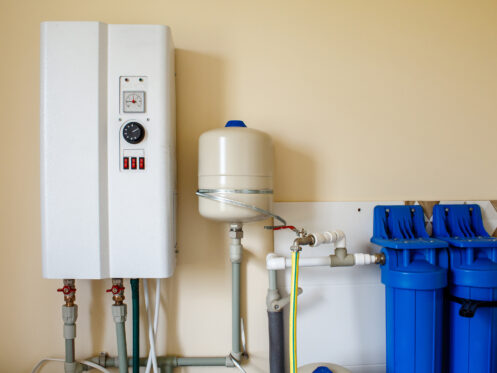
One of the best ways to reduce the environmental impact of your household’s hot water needs is to switch to a tankless water heater. Traditional water heaters need to constantly maintain the temperature of the hot water inside the tank. This requires a significant amount of energy. Any time you use even a small amount of hot water, the water heater must run to heat the cold water that flows into the tank. Some amount of heat is also lost through the tank. This results in the water heater occasionally needing to run even if no one has been using hot water recently.
Tankless water heaters provide hot water on demand, eliminating the energy needed to maintain a large volume of hot water. The fact that they only need to heat a small amount of hot water at a time also means they use less energy when they run. The US Department of Energy estimates that the average household will reduce the energy needed to meet its hot water needs by anywhere from 8% to 34% by switching from a traditional water heater to a tankless unit. The exact savings you can expect depend on the size of your household and how much hot water everyone uses. Smaller households with a lower hot water demand will see the highest savings.
2. Upgrading to Low-Flow Plumbing Fixtures
Despite the US mandating the use of low-flow plumbing fixtures in 1994, a surprisingly large number of homes still have some outdated, standard-flow fixtures. Replacing just a single inefficient faucet or shower with a new low-flow fixture can save hundreds or thousands of gallons of water per year.
In the case of an old toilet, replacing it with a low-flush model can save more than 10,000 gallons of water in a single year. The main reason that many people are hesitant to make this switch is that they’re concerned that low-flush toilets don’t work as well. It’s a misconception that low-flush toilets require multiple flushes or clog more frequently. This was often true in the past when low-flush models first came out. However, technology has improved to the point that this is no longer the case. Upgrading to a dual-flush toilet can result in even greater savings. These models have a standard flush for solid waste and a smaller flush for liquids.
3. Installing a Smart Leak Detection & Shut-Off Device
Hidden leaks, running toilets, and dripping faucets are huge contributors to water waste. Because of this, it’s essential that you try to avoid these problems as best as you can. The most effective option in this regard is to have a plumber install a smart leak detector on your main water line. This type of device monitors your water usage and will send an alert if it detects an abnormal increase in usage that’s likely related to one of these problems. It continually performs checks, allowing it to accurately discern the difference between normal usage and an increase due to a leak. Most smart leak detectors have automatic shut-off as well. It will immediately turn the water to the house off if a serious leak is detected. This ensures that you won’t come home to find your home flooding should a major leak ever occur.
4. Insulating Your Hot Water Pipes
One of the simplest upgrades you can make to lessen the environmental impact of your plumbing is to insulate exposed hot water lines. Also, insulate the pipes that run inside an exterior wall. Some energy and water are wasted due to hot water losing heat as it travels through cool pipes on the way to your plumbing fixtures. This is true regardless of whether you have a tank-based or tankless water heater. The further away the fixture is from the water heater, the more heat the water loses. The heat loss also means that you need to let the water run for longer before it finally gets hot. This can add up to significant waste of water over time. By insulating your hot water lines, the water won’t lose nearly as much heat. That means you’ll avoid wasting as much energy and water.
5. Installing a Water Filtration System
Installing a water filtration system for your home won’t technically lessen the environmental impact of your plumbing system. Instead, the benefit lies in ensuring that you have access to fresh, clean drinking water, eliminating the need to rely on bottled water as much. Producing plastic for bottled water requires a large amount of energy and oil. You also need to consider the impact of transporting the water. With a water filtration system, you’ll lower your carbon footprint by no longer needing to buy bottled water to drink at home.
Upgrade Your Plumbing With Anderson Heating, Cooling, Plumbing & Electric
If you’re looking to upgrade the plumbing in your home, Anderson Heating, Cooling, Plumbing & Electric is ready to help. We’ve been serving homeowners in Mentor and the Greater Cleveland area for over 40 years and have a reputation for quality work, affordable prices, and exceptional customer service. Whether it’s upgrading your bathroom plumbing with low-flow fixtures or tankless water heater installation, you can trust us to get the job done right.
For more information or to schedule service, contact the team at Anderson Heating, Cooling, Plumbing & Electric today.